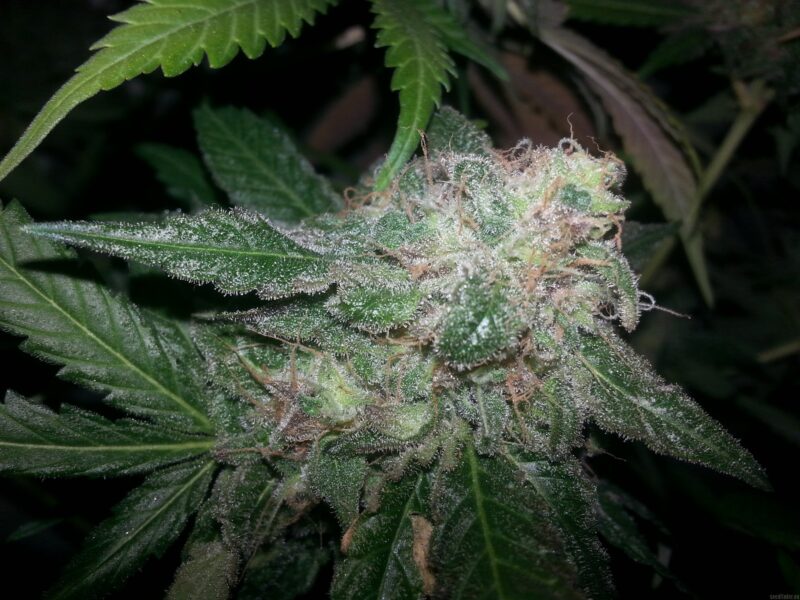
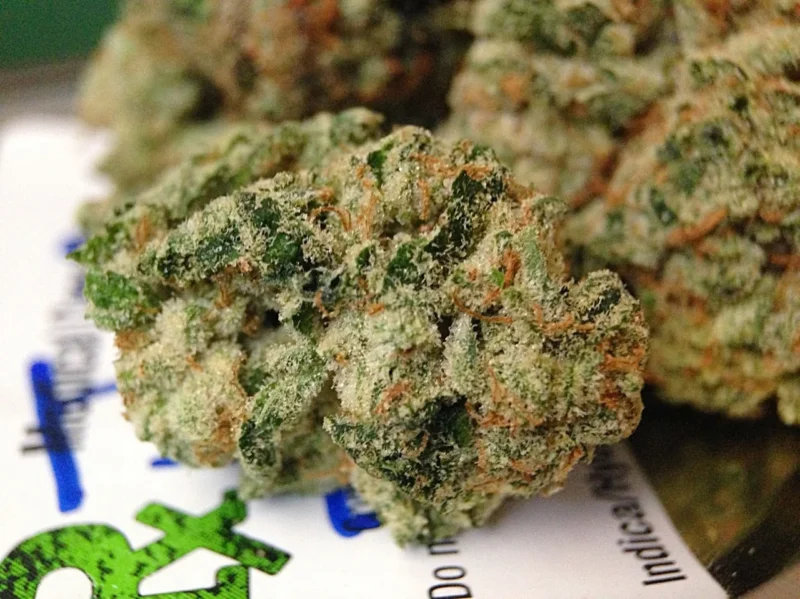
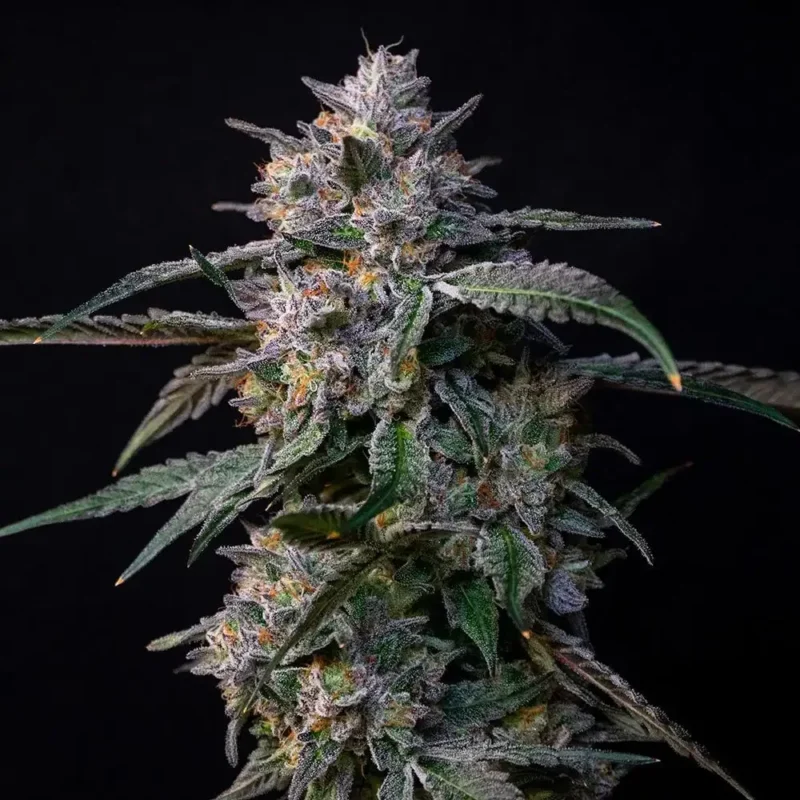
Chronic
Chronic is an indica dominant hybrid. Its flavor notes include strawberry, sweet and fruity.
Updated
Strain at a glance
- Reported type
- Indica dominant hybrid
- Reported THC
- 20%–22%
- Reported CBD
- 5%
View the classification diagram

Classification is conventional. Cannabinoid measurements vary by batch.
- Reported lineage
- Northern Lights × Skunk × AK-47
- Reported flavors
- Berry, Fruity, Honey, Strawberry, Sweet
- Reported effects
- Creative, Euphoria, Giggly, Happy, Relaxing, Uplifting
Chronic genetics
Northern Lights × Skunk × AK-47.
The conventional classification is 20% sativa and 80% indica.
Flavor and aroma
Chronic combines strawberry, sweet, fruity and berry in its flavor profile. Additional notes include honey.
The aroma adds flowery, earthy and spicy.

Chronic effects
Reported Chronic effects include creativity, euphoria, giggling, a happier mood, relaxation and uplift.
Chronic THC level and CBD
The published Chronic THC level is 20–22%.
CBD is listed at 5%.
For a specific product, use its batch laboratory results rather than treating these figures as universal strain specifications.

Related strains
Explore the indica dominant hybrid directory for other profiles in this classification.
Questions about Chronic
Is Chronic indica or sativa? It is classified as an indica dominant hybrid. The listed split is 20% sativa and 80% indica.
What does Chronic taste like? The available description includes strawberry, sweet and fruity.
Who bred Chronic? An original breeder has not been established in the available evidence.
Sources for Chronic
Profile updates2
Profile text updated.
Profile text updated.
Image credits & editorial sources
About Chronic
Chronic is associated with a substantial central flower, relatively sparse side branching and a sweet, honey-like aromatic account. Serious Seeds describes a line introduced in 1994 and revised around 2000 with AK-47 material. Its published grow report follows three female plants with different structures and harvest weights, including an unusual topped individual that performed well despite the breeder’s general advice against topping. The history and that individual example make Chronic more interesting than a simple high-yield label.
Chronic strain information and its two breeding periods
The Serious Seeds Chronic page identifies the current offering as an F1 sativa/indica hybrid and supplies both regular and feminized seed options. The producer associates the name with substantial flower production and a medium-height plant. The seed category and the particular version matter when comparing a modern listing with an account written about the original 1990s line.
The historical text dates the introduction to 1994 and describes a later improvement in 2000. It says the earlier Chronic did not contain AK-47, while the revised line did. That is a concrete distinction between two periods in the producer’s account. A historical photograph or description should not automatically be assigned the modern pedigree merely because the central name is unchanged.
The producer credits Simon with the revision and explains that he wanted to retain the yield and sweet aroma while changing the overall experience and resin characteristics. Those are the breeder’s stated aims. They provide context for the change without establishing a controlled before-and-after measurement of every trait.
Chronic genetics and the nested family description
Chronic genetics are summarized in the existing profile through Northern Lights, Skunk and AK-47. The Serious Seeds grow report gives the more detailed notation Northern Lights/Skunk × Northern Lights/AK-47. Its main product text also describes AK-47, Northern Light and a Northern Light/Skunk cross. Those differently expressed accounts are kept at their stated level of detail rather than converted into a new, supposedly authenticated mating sequence.
The repeated Northern Lights name is meaningful in the producer’s formula. It should not be removed merely to make a three-name list look simpler. At the same time, a repeated name does not establish that two references concern the exact same parental clone or a documented numbered selection. The source does not provide that chain of identity here.
The historical account explains why AK-47 appears in the modern description but not in the original line. This is useful release history, not a reason to merge every Chronic descendant with AK-47. A contribution to a later breeding program remains different from genetic identity between two named cultivars.
The source calls the modern line a sativa/indica hybrid and discusses its mainly-indica background. The existing broad profile records 80% indica and 20% sativa. The producer page does not establish an exact new percentage that should replace that original reference. The historical statement that more sativa was introduced also does not supply a numerical calculation of the change.
The central-cola growth habit
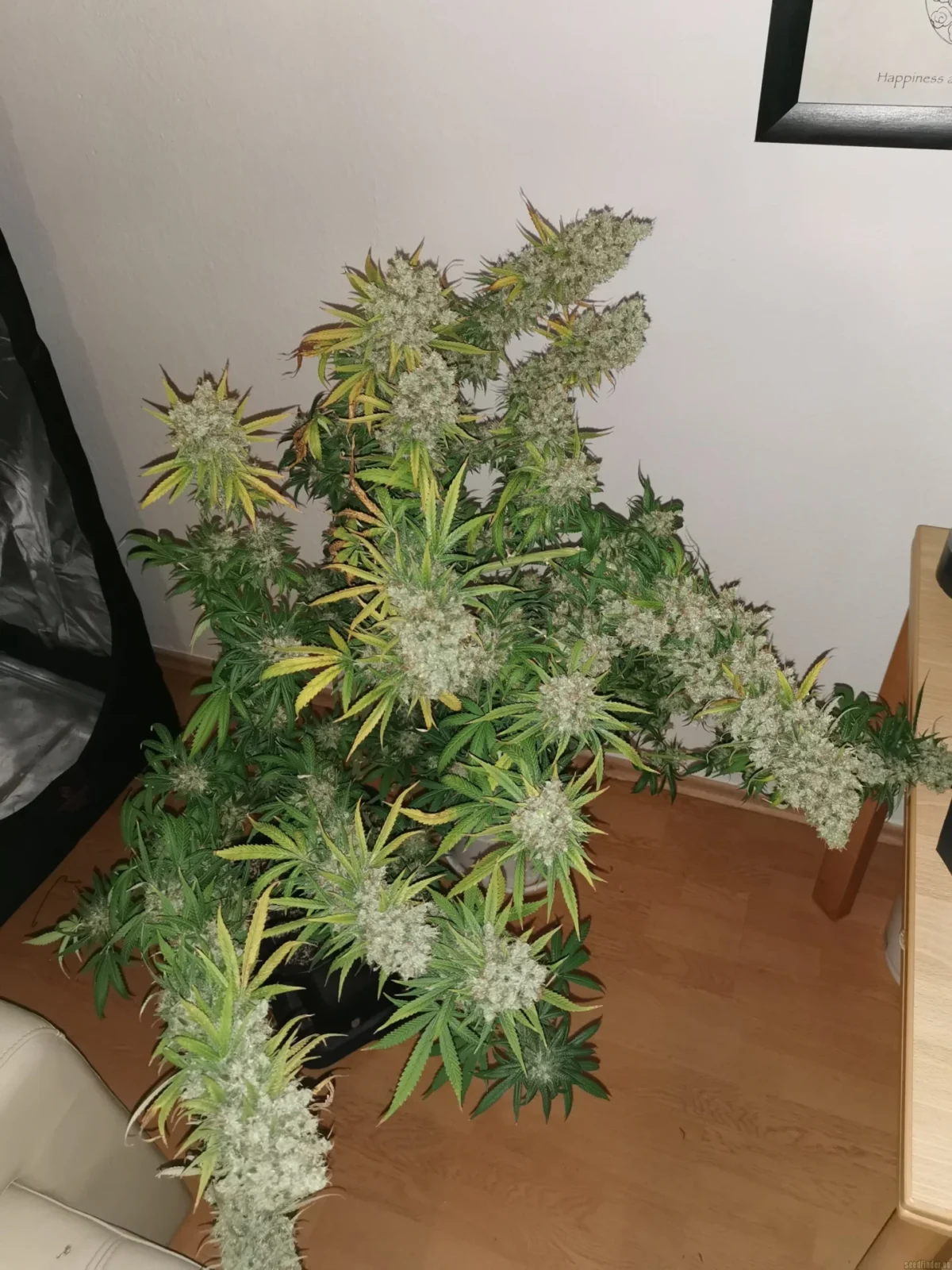
The recurring Chronic structure is a large central flower with comparatively few side branches. Serious Seeds describes a medium-sized plant that is not exceptionally leafy or dense as a whole, while its mature flowers can be dense. These statements refer to different features: overall branching and foliage are not the same thing as the compactness of an individual flower cluster.
The favorable flower-to-leaf ratio is part of the source’s growing description. In the embedded report, that characteristic is associated with relatively straightforward harvest processing. It is a qualitative observation rather than a measured labor saving or an assurance that every plant requires the same amount of trimming.
The source’s general advice is to avoid topping and favor the central-flower structure or a selected set of side branches. Its grow report contains an interesting exception: a plant pruned for clone production became the strongest-yielding individual in that small group. The exception is retained as an observation, without turning one successful plant into proof that the general recommendation is always wrong.
Flowering specifications that do not quite agree
The current product summary gives three to four weeks of recommended vegetative growth and nine to ten weeks of indoor flowering. Elsewhere on the same page, the descriptive text gives 53–63 days, or eight to nine weeks. The embedded cultivation table gives a general expectation of 60–67 days. These are different source specifications, and their overlap does not justify silently replacing them with one exact finishing day.
Flowering time also needs to remain separate from total time after germination. A nine-week flowering description does not include an additional three- or four-week vegetative stage. The grow report is particularly helpful because it records the transition and the individual flowering durations rather than supplying only a broad catalog interval.
The source’s outdoor summary says mid-to-late October. It does not supply enough location-specific detail to make that a universal finishing date. The same named line can be described through an indoor light-cycle interval and an outdoor calendar expectation, but those are different ways of recording time.
Yield figures also vary within the page. The main specification gives 350–600 grams per square meter, and the older report discusses up to 600 grams per square meter. One descriptive passage mentions up to 800 grams per square meter. This supplementary account retains the disagreement; it does not select the largest number as a new verified performance claim.
G.B.I.’s three-plant grow account
The grow report is credited to Green Born Identity, or G.B.I., and describes Mr. Power Planter sowing five regular Chronic seeds, three of which produced female plants. That observed result belongs to one small grow. It is not a germination guarantee, a fixed sex ratio or a population-level estimate for the seed line.
The plants were grown in soil in fifteen-liter pots, using a drip-feeding arrangement. Flowering was induced 33 days after germination by moving to a twelve-hour light period. The account says the plants showed their sex within five to seven days of that change. These are recorded milestones from the described setup, not a schedule that every seed-grown plant must follow.
The cultivation table lists 1,000 plus 600 watts of HPS lighting, day temperatures of 24–28°C and an eighteen-degree night temperature. It gives 40–75% relative humidity, a pH range of 6.2–6.8 and nutrient-solution EC up to 2.0. Those values help identify the conditions under which the observations were made; the report does not test them as optimum settings.
The setup details also make the harvest numbers easier to interpret. They concern particular seed-grown plants in a particular room and container system. They should not be converted into a modern LED efficiency figure or an expected harvest under a different planting density when the account does not provide the evidence for that conversion.
Three different Chronic plants in the same report
The first plant, which had been pruned for clone production, finished at 102 cm. The writer describes five substantial upper flowers and four additional well-formed lower tops. It completed flowering in 66 days and produced a reported 85 grams. The account explicitly treats its strong performance as an unusual individual response rather than a general reason to disregard the breeder’s topping advice.
The second plant finished at 94 cm, with a large central flower and developed side flowers. Its reported flowering duration was 68 days and its harvest weight 58 grams. The third finished at 80 cm after 65 flowering days and produced 47 grams. These individual observations show why a seed line’s overall description should not be mistaken for three identical plants.
The report’s three weights add to 190 grams, but that simple sum is not an area-based yield. The text does not allocate a measured growing area to those three plants in a way that supports a clean grams-per-square-meter calculation. It is therefore more useful to retain the individual weights beside their respective plant sizes and flowering times.
The longest-finishing individual in that group, at 68 days, also slightly exceeds the table’s 60–67-day general interval. That difference is small but worth retaining. The recorded grow provides an observed range of 65–68 days, while the product page’s several broader specifications remain separate reference statements.
The two larger plants also make an instructive comparison. The 102 cm Chronic finished in 66 days and produced 85 grams; the 94 cm plant took 68 days and produced 58 grams. In this account, the plant with the longer flowering interval was not the higher-yielding one. Structure, individual variation and the earlier pruning history remained part of the comparison. The figures do not support predicting harvest weight from height or flowering duration alone.
Adding the recorded 33-day vegetative stage to the individual 65–68-day flowering durations gives a calculated interval of 98–101 days after germination. This arithmetic is only a way to interpret the report’s timeline. It excludes drying and other later handling, and it does not establish a universal complete growing cycle for Chronic. It is nevertheless a clearer comparison than treating one of the page’s flowering numbers as the total time involved.
The observed 65–68 flowering days amount to approximately nine weeks and two days through nine weeks and five days. That fits inside the current summary’s nine-to-ten-week description, while running beyond the shorter 53–63-day passage. The source can therefore be read coherently without erasing the discrepancy: its actual reported plants matched one published interval more closely than another. The original source figures remain visible rather than being rewritten to make every section agree.
Harvest processing in the account also emphasizes plant form. All three plants are described as having dense flowers and a favorable flower-to-leaf ratio, despite their different total weights. This separates a shared morphological observation from performance variation within the small group. A useful Chronic comparison can retain both, instead of reducing the report to the single largest harvest number.
Sweet aroma, drying and the source’s conflicting descriptors
The longer Chronic account emphasizes a sweet honey or wildflower-associated aroma with a mild spicy quality. Its discussion of drying is unusually prominent: the breeder and report writer describe the smell as subtle during growth and sensitive to the handling of the harvested flowers. That gives useful context to differences between a living plant’s odor and the aroma described after drying.
The producer warns in the embedded account that enclosing insufficiently dried material in plastic can damage the desired aroma. This is a source observation about maintaining that aromatic character, not a complete storage or microbiological safety protocol. No contaminant test, moisture specification or validated shelf life is established by the description.
One part of the current page instead describes a strawberry aroma. That does not match the honey and wildflower emphasis in the longer historical and grow-report material. The difference is left attributed rather than treated as proof that every Chronic plant has a pronounced strawberry flavor. No specific terpene concentration is supplied to reconcile the sensory accounts.
The original flavor descriptors in the profile remain above. The supplementary review adds the source’s honey, floral, spice and strawberry wording with its context intact. It does not replace the stored fields with a cleaner-looking but unsupported single aromatic formula.
Chronic effects and the reported experience
Chronic effects are described by Serious Seeds through a strong physical component with relaxing, meditative or creative qualities also mentioned. In its breeding-history discussion, the producer says the AK-47 contribution made the experience more complex while retaining the earlier line’s desirable characteristics. That is the breeder’s experiential explanation of the revision.
The report writer describes the finished material positively, but these are attributed impressions from the source account. Hemp Lookup did not repeat the grow or consume the material. The account supplies no standardized amount, blinded comparison or response frequency from which to predict how another person would experience a different sample.
The existing profile’s effects list remains a separate collection of reported descriptors. A physical effect, a creative impression and the broad indica/sativa category can all appear in the same source without establishing a medical outcome. No treatment claim, fixed duration or guarantee of a particular mood follows from those descriptions.
Chronic THC level and the unusually different CBD references
The Chronic THC level recorded in the existing Hemp Lookup profile is 20–22%, with a recorded CBD figure of 5%. Those original numerical fields and their source date remain unchanged. The Serious Seeds page reviewed here instead uses qualitative high-THC and low-CBD categories. It does not provide a matched laboratory report that resolves the difference.
The CBD distinction is substantial enough to keep visible. A qualitative low category should not automatically overwrite the stored 5%, while that older reference should not be presented as a batch guarantee. The two statements come from different records with different scopes, and the source material examined here does not establish a justified numerical replacement.
Nor can the harvest weights, resin coverage or a reported strong high supply a cannabinoid measurement. The G.B.I. grow account is useful cultivation evidence, but it is not an exact product-lot chemistry report for this profile. No THCA figure, contaminant result or safety verdict is inferred from it.
Chronic in the Serious Seeds family
AK-47 is the most useful related profile for understanding the modern Chronic account because the producer explicitly identifies its later contribution. White Russian supplies a different comparison: it combines AK-47 and White Widow in a separate breeding account. Shared AK-47 ancestry does not make Chronic and White Russian the same cultivar.
The source also supplies dated award claims for Chronic, including a third-place High Times result in 1994, La Bella Flor in 2003, Highlife results in 2004 and later extraction-category results in 2016. These claims remain attached to the producer’s page. An extraction award is not automatically an award for a current flower sample or proof of its chemical composition.
The clearest research outline combines the two breeding periods, the central-cola growth description, the varied published flowering specifications and the detailed three-plant account. Those details let readers compare evidence instead of relying only on the name’s commercial reputation. The Serious Seeds page was read on 13 November 2026 for this supplement; the original profile’s recorded source-check date is preserved.
Community reviews
Experiences shared here are personal reports. Every review is moderated.
No published reviews yet. Have experience with this strain? Share what you noticed.